
Evolution
One of the best things about the current market is that some brands are willing to push the boundaries of what works in a football boot. These are of course, the halo products, or products that exist simply because the brands want to show off what they can do. This gave us boots like the adidas F50+, as well as others like the Puma Ultra Carbon. With many halo products, and especially in the case of the two boots previously mentioned, the boots are not always the most functional products.
Rather, they are boots that, in my opinion, would not be boots that could be used as a go-to boot. This is normally par for the course for most halo products in general, as conceptually they are closer to what could be more common tech across the board in future, instead of something for the here and now.
However, the new adidas F50 Hyperfast EVO bucks this trend. While the boots are absurdly light (130g/4.58 ounces), as well as having a ridiculously thin upper, they are engineered in such a way that they feel functionally like a regular inline product. The boots are far more practical than one might expect, and an evolution of the halo product concept.
Fit and Feel

While the most noticeable thing when unboxing the adidas F50 Hyperfast EVO is how ridiculously light the boots are in hand, the extremely thin upper is a close second. The HALOSHELL SL+ upper is ludicrously thin, to the point where one could be forgiven for thinking that the upper would disintegrate easily. In spite of this, in reality, the upper feels remarkably well-built in hand.
There has obviously been a lot of engineering that has gone into the creation of this upper, and it feels much stronger than SL uppers of the past.
When the original adidas F50 adiZero came out in 2010, the box was so light that it felt like there was not a pair of boots in the box at all, and the same goes for the F50 Hyperfast EVO. Visually, your brain will lead you to expect the box to feel heavier than it actually is. The boots are comically light in hand and on feet.

Since the upper is so thin, the overall shaping is much more neutral than the F50 Hyperfast Elite. This means that even those with wider feet will have an easier time getting the adjustability and fit that they want. Jezusftbl’s video is a good example of this.
At the same time, this does not mean that the fit feels sloppy. This is partially due to the deep lacing system, as well as the standard floating tongue, which allows for plenty of adjustability to the fit.
What also helps make the boot feel less sloppy is the addition of the HALOBELT-like reinforcement cage found through the midfoot. This helps boot wrap around the foot better and aids the overall fit. It also adds some extra structure to the midfoot and helps a little bit with overall stability.

However, the thin upper does mean that there is not a lot of midfoot stability here. While I do not find the rollover to be bad in the F50 Hyperfast EVO, it is not as good as what is found in the Elite model.
One of the major advantages of the thin upper is that there is not much to break in. The upper takes to the shape of the foot easily. This means that the boots feel ready to go pretty quickly as again there is not much there to get used to.
For the overall lockdown, I would say it is good enough, and the lacing system does help with this, but again, the boot does not have the kind of lockdown that you might expect from other speedboots on the market, like the Sokito Scudetta Biotouch, for example.
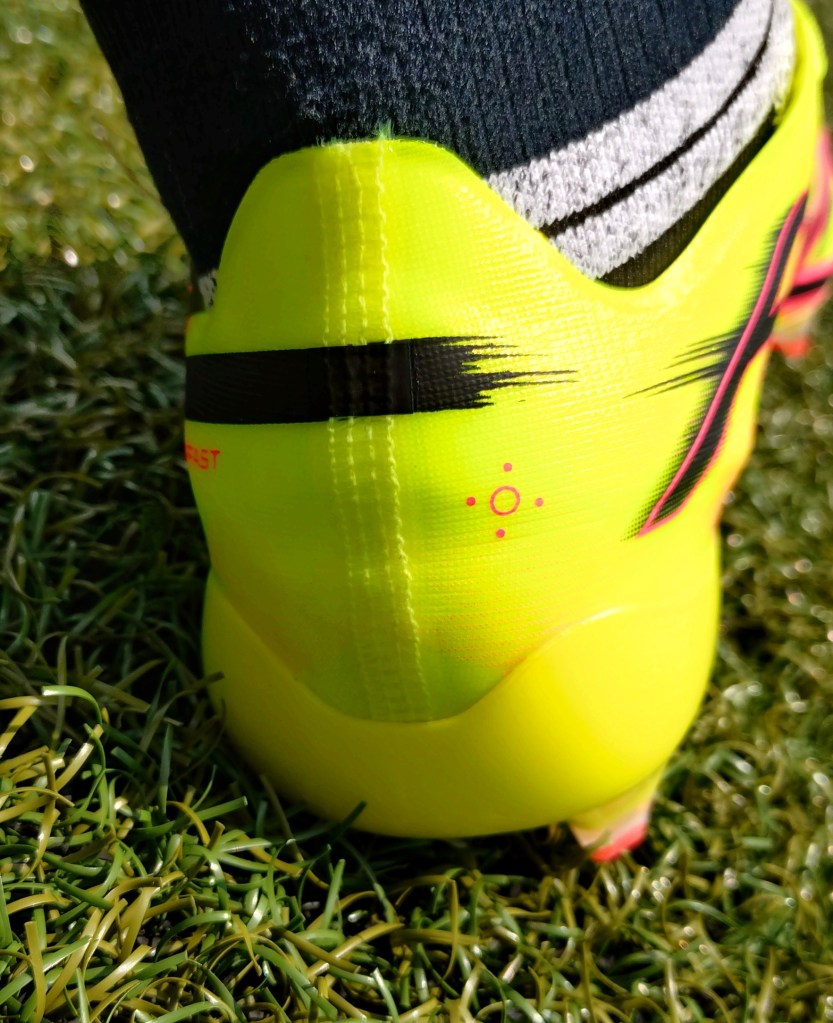
A massive heap of praise needs to be given to the heel design. When designing a boot this light, it would be understandable if adidas went with a basic heel in order to help keep the weight down. Notably, not only does the heel fit nicely, it also has a nice amount of cushioning. It is one of those things that makes me impressed with the amount of thought and engineering that went in the creation of the EVO.
It would be a stretch to say that the boots are overly comfortable, but they are not uncomfortable either, and it is nice that fit and comfort are not sacrificed in the name of lightness.
For sizing, much like the F50 Hyperfast Elite, I find the Hyperfast EVO to run slightly long. Because of this, I went half a size down from my normal size. This means I got a size US 8/UK 7.5/EU 41.5/JP 26. Since there is not much to the upper overall, some people could theoretically go half a size down, similar to what I did. I would say that if you have wider feet, you should still go to true to size, whereas if your feet are slightly narrow, half a size down might be the better choice.
On the ball

The adidas F50 Hyperfast EVO might be the boot with the thinnest upper I have played in. Naturally, this means that there is almost nothing between the boot and the ball, which means the touch on the ball is as razor-thin as possible right now. And yet, this feels like an advantage, even for me, being someone who wears leather boots a lot of the time, there is a certain confidence on the ball.
Again, there is so little in the way of the touch on the ball that it is all down to the person wearing the boots.

There is also a slight roughness to the upper, but it certainly does not have the kind of grip on the ball that the Elite model offers. Still, the upper is certainly not slick, either.
I do also find that there is somewhat of a pingy sensation on the ball when adding force. Shooting is fun and distraction-free, and the same can be said about dribbling. Again, there is this quiet confidence that I feel when on the ball in the F50 Hyperfast EVO, and while part of that is certainly mental, I do feel that the boot adds to this perception.
Grip

Overall, the soleplate is still on the aggressive side, and certainly more aggressive than the previous generation of the F50. It does feel somewhat toned down when compared to the Elite model, but it still feels like a speed boot would be expected to.
Interestingly, this somewhat toned-down soleplate works surprisingly well on AG, I do not experience much drag when cutting and turning. Despite this, I still do not recommend that you wear these boots on AG, as not only will it void your warranty, it is still less safe than an AG-specific soleplate.
Another positive is the fact that the boot still has the normal four heel studs, as this means the boot feels more stable when playing. I have never been much of a fan of brands switching to three back studs when trying to shave the weight off of a boot.

The F50 Speedsystem EVO soleplate is nice, and I do like the feel underfoot. There is still plenty of aggressive traction, without feeling over the top. Also, quick aside, I have no idea why adidas put “The F50 Speedsystem EVO” on the soleplate rather than just dropping “the” from the soleplate’s name. Seems like a weird choice, grammatically.
adidas F50 Hyperfast Elite versus adidas Hyperfast EVO comparison

The choice between the two models really comes down to what you prefer from your speed boots. If you want more traction, lockdown, stability, comfort, as well as some more grip on the ball, the Elite is the better choice.
However, if you want to feel freer in your boots, with a super thin touch on the ball, while still having some aggressive traction, the EVO is the better choice.
Personally, the Elite is my choice between the two, but I could see a world in which I wear the EVO instead. Again, it comes down to your personal preferences in a boot.
Durability

While no boot is going to last forever, I think it is a mistake to assume that any superlight boot will immediately have issues with durability. In my three one-hour playtests in the EVO, I have not noticed any separation or felt like the boots were already breaking down.
Historically, boots with uppers this thin and light felt like you could tear them apart with your hands alone. Yet, the EVO feels surprisingly sturdy. I do not think it will be more durable than the Elite model, and the EVO also requires more upkeep with cleaning and the like. Though I do feel that the boots will last longer than many might expect from a boot that is this light.
Evolution of the halo boot

We have come a long way in the past decade, and the EVO is proof of this. The halo model that many brands are beginning to embrace has, within one generation, gone from something that is unique, yet impractical, to a boot that could be worn for matches week in, week out.
An impressive amount of engineering and design has gone into the adidas F50 Hyperfast EVO, to the point where the F50 from the previous generation feels like they were made half a decade ago. There seems to be a new, more practical mode of thinking going on behind the scenes, where a design team gives their maximum effort to deliver something truly impressive. This is not to say other boots are not like this, but rather to reinforce the fact that the Hyperfast series is a massive step forward for adidas. As for the EVO itself, it is such a wild and interesting boot yet still retains a practicality to it.
The bar for halo boots has been dramatically raised. It will be interesting to see how other brands respond.
Now give me a colourway with a black base or a white base, adi.
What do you think of the adidas F50 Hyperfast EVO? Please share this with your friends and make sure to follow me on Instagram!
Also, check out the Football Boot Hour Podcast I co-host with Boot Wizard!
If you like this review, please consider supporting by buying me a Ko-Fi or making a donation through the Support The Blog sidebar!
I split my time between wearing HAVO Grip Socks and PureGrip Socks for training and matches.
Use code LOCKHART15 to get 15% off your HAVO Grip Sock order or click the link here: https://havosports.com/LOCKHART.
Use code lockhart for 10% off your entire PureGrip Socks order here: https://puregripsocks.com. Along with the socks, I also recommend the Pure laces and Pure Carbon 2.0 shin guards.
じゃあね!


Hey! I went half size down, but the boot feels a bit short length wise. From your experience, does it adjust a lot? I was Puma Evospeed SL lover for years and always got a half size smaller, because they were easy to stretch in all directions and adjusted perfectly.. But Im feeling this upper has more structure, so Im a bit worried they are not gonna stretch enough and I will end up with boots too short, which considering the prize would be a disaster .
thank you!
Martin
LikeLike
Hey! Wear them around your home for a bit and see if you feel them stretch, if not, get that half size up.
LikeLike